Showing posts with label Tabletop Gaming. Show all posts

Monday, February 25, 2019

Gloomhaven Campaign Notes, Vol. 1 (Start up, and Scenarios 1 through 3)

Looking back on 2018, it was a year where we really ramped up to a new style of game within the Fitzgerald household.  We've taken to campaign/legacy games and complex co-op games.  New house, new games I suppose!

While our original favorite series of games (Railways of the World) was sufficiently complex, it was never the "hotness" of the hobby tabletop board game community.  However, in 2018 we ramped into a lot of the Board Game Geek top 20 list and have found a lot of love in Terraforming Mars, then Viticulture, then Pandemic Legacy Season 1 (see shadowbox below, minor spoilers, made as an awesome gaming room decoration by Kelley following our completion of the campaign), then Spirit Island, and finally Gloomhaven.  As you can see, a move towards legacy games and also towards co-op games.


Yes, I took the plunge on Gloomhaven at the end of 2018 when I could get it on a deal.  And then proceeded to soak in a lot of YouTube videos, reddit threads, and the like on both organizing the behemoth of a game, and then preparing for our first plays.  Indeed, I think organizing the game was almost as much fun as preparing for the first play, but that's just me.  For reference, I went with the YASS solution using Plano boxes and a separate file folder for the map tiles, to make setup as quick and easy as possible.  Better cost-wise than investing in one of the Broken Token organizers, as I don't want to commit to doubling the cost of such an expensive game until I know it's a household classic for us.  We will also be playing with the Gloomhaven Helper app, as it cuts out over 50% of the fiddly component overhead and smooths the gameplay experience significantly, in my opinion.

Kelley initially expressed intimidation by the sheer bulk of the game components, etc. but I think it's about the same or perhaps less complex than Spirit Island, which we've both taken to really well (it doesn't help that the theme, while very Game of Thrones, does not appear to be really her thing).  So we will see how it goes.  If nothing else, I think I will play the game solo even if Kelley doesn't like it for the long term, as the puzzle-solving nature of the scenarios is a lot of fun for me.  As hobby gamers, it would be silly for us to not try the consensus number 1 game of the past 3-4 years, so we'll try it and see if it hits as well as the other complex and/or campaign games we've been enjoying.

So to the campaign.  Since this is a narrative story, I'm going to keep records of how we did to look back at later and enjoy, assuming (again) that we end up loving this game over the long haul.  Our party starts with a Cragheart named Hamilton (me) and an as-of-yet unnamed Spellweaver (Kelley).  We grab some initial items from Gloomhaven town and head out on our first mission.

Black Barrow, Scenario 1

On the road we had a chance to shoot at some birds to try and make a meal, but we opted not to waste our arrows.  Having no negative effect, we climbed down the stairs into the Barrow and faced our multiple rooms of opponents, mostly some guards and archers.  I didn't do a full on rules explanation to Kelley beforehand, so we just played with all Level 1 cards and learned as we went.  I also set the difficulty on easy (0) because this is apparently the hardest the game gets when your initial characters don't have much perks/items and you don't know what you're doing yet.  Only major rules mistake from Scenario 1 that I know of is we forgot to draw Battle Goal cards, so we didn't end up with a chance to earn some checkmarks towards perks on the character sheet.

Regardless, we handled the three rooms of the Black Barrow without too much hassle.  The Spellweaver ended up within a turn or two of running out of cards exhaustion, but it feels like that's going to be normal given the small beginning hand size of 8, even with the one card that allows her to reclaim all from the lost pile.  We made it to the end to find that our quarry was in another castle, so to speak.  We did manage to loot the treasure chest in the final room, opening up a new scenario off in the mountains that looks a bit intimidating for our starting party.

Although we kept the personal goal cards secret during the first scenario/play, after more research online it seemed that our duo would work better if we knew about each other's personal goals and quests.  Not so much to be able to predict or control character retirement, but just to help explain the motivations of the characters and give them more depth.  So we did that, Kelley is on the quest for augmenting ability cards which we obviously haven't unlocked yet.  My quest is element hunting, which requires completing a scenario in 6 different world regions on the map, so that will take Hamilton the Cragheart a while as well.

Barrow Lair, Scenario 2

For our second play, we started up by just going to the linked second scenario rather than heading back to town, as we didn't earn enough gold or XP to make any big changes yet.  We did up the difficulty to normal (level 1) based on how successful we were when on easy in the first scenario.  In this scenario, you work through an initial small room and then go into a central room with 4 other new doors leading off of it, which is also where you have your first encounter with a boss character.  His special abilities are (1) raise the dead and (2) jump around the room opening those other 4 doors, which of course have rooms with more bad guys behind them. He also had 2-3 times more health than a normal minion we've encountered so far, so this will be a grind of a fight.

To be continued...


Sunday, January 15, 2017

BuckeyeFitzy's Top Tabletop Games of 2016

Having become somewhat of a regular guest on The Geek All Stars podcast in 2016, I was asked to contribute a Top 11 list for board games in 2016. Like most of the contributors, I've played many games but not all the games of course. But when you have a number of different lists combined, I'm sure the end result (released around the end of January) will be pretty accurate.  For example, last year Codenames won, and I would have been fully in agreement.

For reference, the time frame used for "2016" includes all games released between Essen (largest game convention, in Germany in October each year) in 2015 and the day before Essen in 2016.  This time scale provides a fair chance to play things before the end of the year, as many Essen releases take a while to get full release in the U.S. anyway.

You won't find the Scythe type games on this list. Sorry, I just don't have the game groups to support really heavy games, no matter how hyped they are. It also explains why you will see a lot of 2 player games and games appropriate for adults and kids, as that's where the Fitzgerald household is in the year 2016.

Here's my personal list and reasoning for the Top 11 tabletop games of 2016.

Honorable Mentions: 

  • Gobbit (specifically a kid's favorite)
  • Karuba
  • Animals on Board
  • Quadropolis
  • Terraforming Mars
  • Tesla vs. Edison, Powering Up expansion
  • Pokemon Go (it's not a tabletop game, but man did it capture us in 2016)
-------------------------------------------------------------------------------------

Image result for imhotep images board game

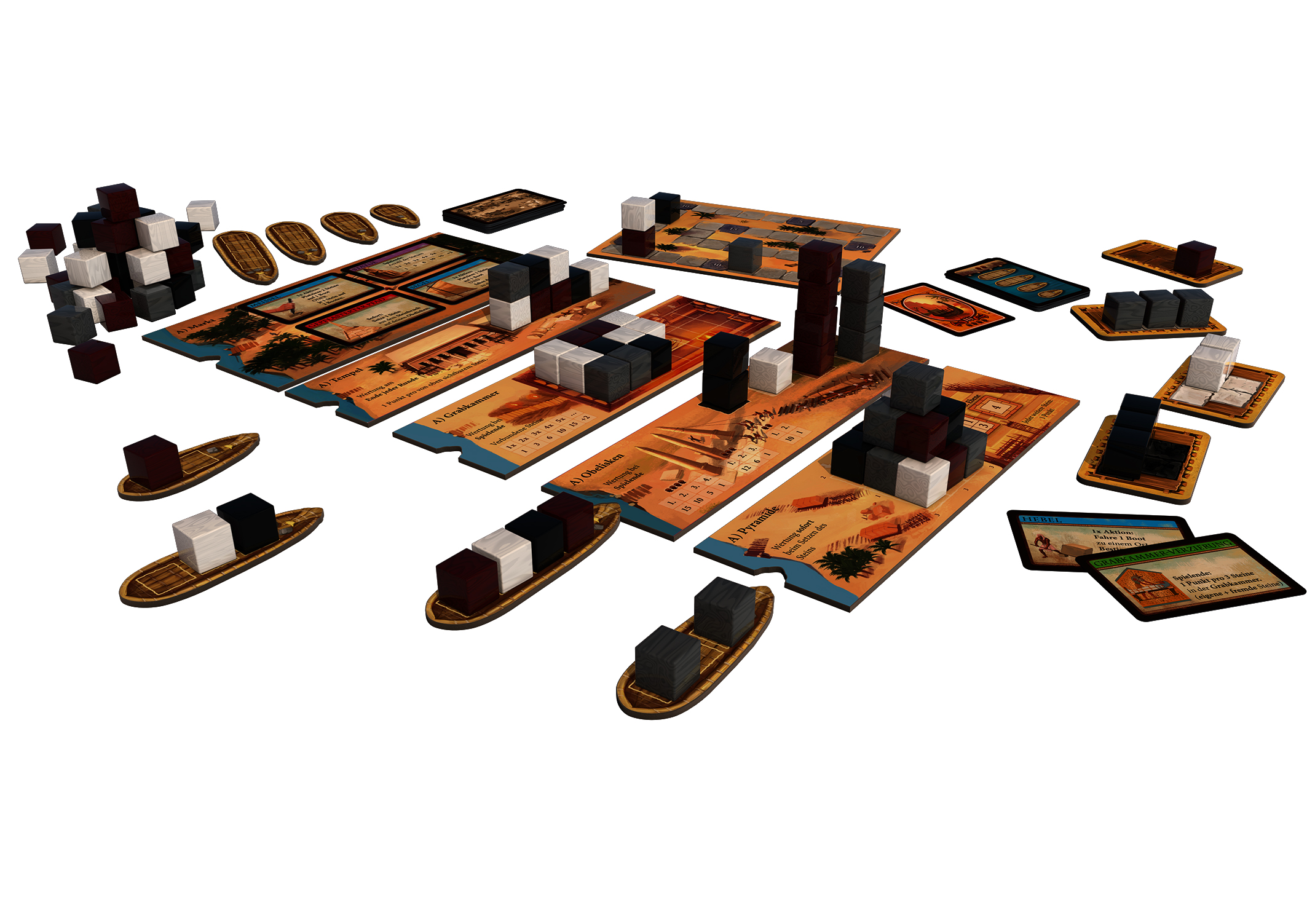
11. Imhotep

One of the three Spiel "game of the year" nominees in this past summer, Imhotep released in the summer conventions to a lot of hype. While it did not beat Codenames for the award, with good reason, this game has an interesting and balanced scoring system where there are multiple paths to victory. Each game plays a little differently, and the double-sided player boards give some longevity for replays. Other than a high level of "screw you" factor with anybody being able to move boats loaded with cubes to ports whether they have a cube on it or not, there's not much downside (but I understand that criticism of this one).


Image result for klask images board game

10. KLASK

Did you enjoy air hockey and knock-hockey growing up? Well I did, and this is a smaller board game version that has a lot more strategy and learning curve to it. You control your paddle with a magnetic piece under the board, and you have to try to put the ball in the opposing goal while avoiding picking up 2 of the 3 little white magnets in the center of the board. Those magnets (if one becomes attached) significantly alter your control. This game is played by kids and adults equally and will be a cherished toy/game for years to come, even if it doesn't fit the normal tabletop types of game.


Image result for junk art images board game

9. Junk Art

Stacking stuff games have been a big hit in our household, whether it is Animal Upon Animal, Rhino Hero, or the like. Thus, Junk Art became an easy hit as a further extension of this type of casual game. For those who want a similar experience as Rhino Hero but with more interesting pieces and a few different rule sets/games to try, this is worth the high cost associated with production of so many distinctive wooden pieces. High quality components are vital to a game like this, and Pretzel Games delivers on that promise. If only they could make a cost-effective one with pieces as big as their demo sets for conventions...!


Image result for save the cupcake images board game

8. Save The Cupcake

Here's a hidden gem, unlike the previous games on the list. A limited independent game release at GenCon, this card game sold so well that it may be re-released again in 2017. I hope it is, so I can buy copies for friends and family. This two player game has a pyramid of cards leading to a set of 6-7 plates, one of which has a cupcake (hidden on the bottom side of the card), while the other player rolls 5 boulders one-by-one down the pyramid of cards to try and crush the cupcake. It's ridiculously fun for a theme, and the strategy is decent while straightforward enough for my 8 year old to understand. This is not just a kid's game, however, as it makes a good 2-player filler game for adults as well.


Image result for dr eureka images board game

7. Dr. Eureka

This is easily the best kid's game for 2016, explaining why it ranks so highly on my 2016 list. Dr. Eureka could become a bit of a classic in this genre if it hits the mass market like other games of the type over the past decade. Adults can also have fun with this game, which requires that you pour marbles from one test tube to another to match a pattern on a card flipped over each round.  The game obviously has quick rounds, but it teaches good critical thinking skills, or refines them in the case of adults. The price point is also great (about $20) for this industry where bloated prices abound.


Image result for quartz images board game

6. Quartz

This is probably the most controversial game in my list, but it gets this high because it has become one of the most played games for us following the 2016 summer game conventions. However, it would not be that way if I had not designed some house rules you can read about in previous posts. This is a classic press-your-luck pulling stuff out of bags game (in this case, "mining" gemstones out of a bag), with plenty of screw your neighbor cards to mix in over a few rounds of play. With fixed rules, this is a good play, but with the normal rules (most importantly, busting out on a round after only 2 bad gemstones are pulled) this is just a luck fest. At $20 or $25, this is a great bargain considering the components, but beware those normal rules in the rulebook!


Image result for the contender images board game

5. The Contender

Another somewhat hidden gem off Kickstarter, The Contender is right up there with Quartz for number of plays we have gotten out of a game in 2016 (AKA, a lot). This was a perfect election year release, allowing for witty presidential debate style game play based on real quotes from U.S. presidential candidates. Add in some 2016 primary cards and some politically incorrect expansion cards, and this holds its own with Cards Against Humanity. While actually having historical quotes on the bottom of the card you could learn from while having fun. Kudos to politics and podcasting nerd Justin Robert Young on a great success in his first-ever game release.


Image result for potion explosion images board game

4. Potion Explosion

One thing I love in tabletop games is innovative concepts, as things like the cube tower in Shogun/Wallenstein and deck building games (starting with Dominion) have captured my attention a lot in previous years. The next two games on this list add similar interesting components which may be used uniquely and well in one game, or maybe adopted in future game designs as well. For Potion Explosion, you are pulling potion ingredients in the form of marbles from a box with a number of angled tracks that roll the marbles down. When you pull a marble out, if the two marbles that roll into one another are the same color, you collect them as well. It feels like a real life tactile version of match-3 games like Candy Crush, and it's incredibly satisfying. Great unique idea for this game.


Image result for mystic vale images board game

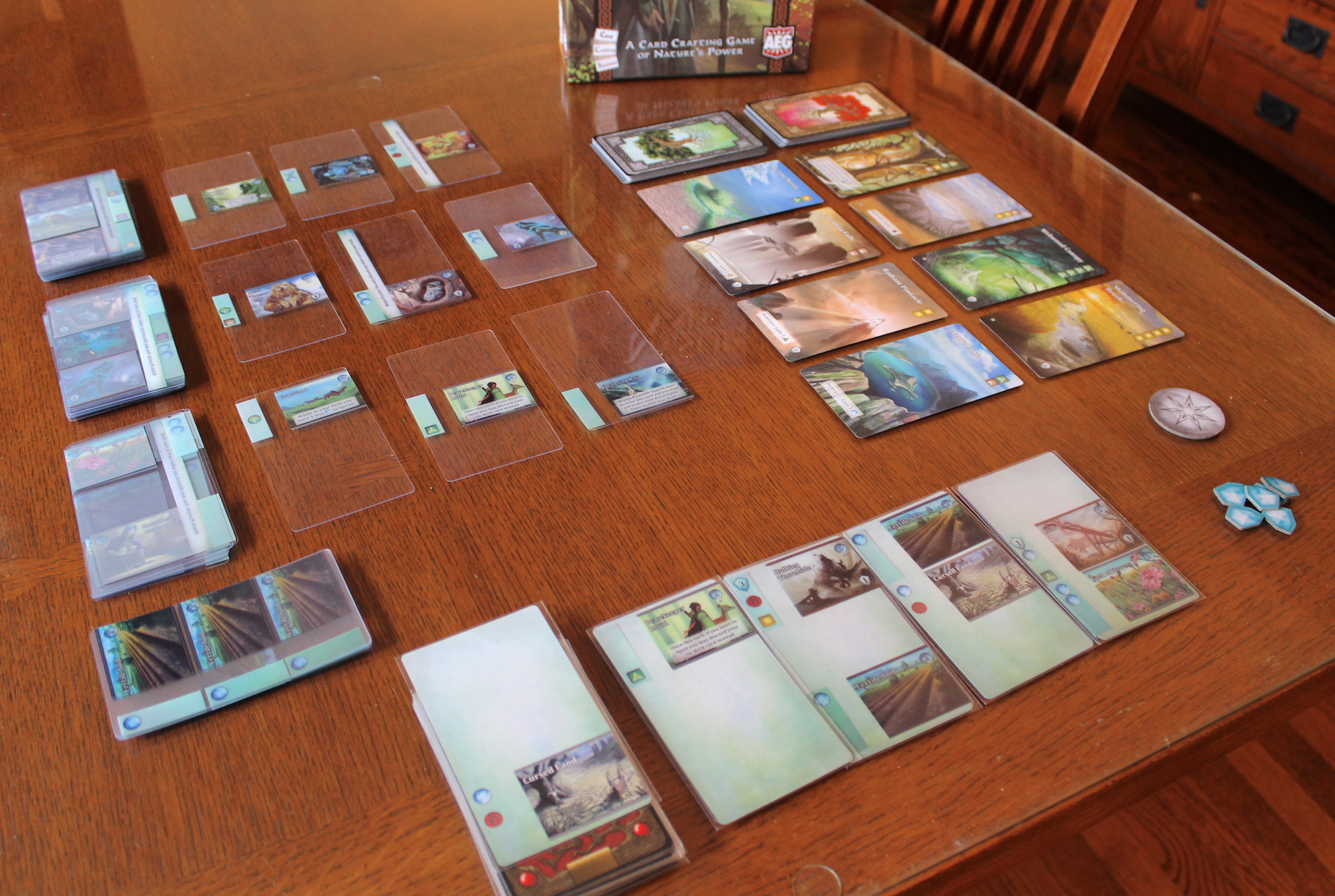
3. Mystic Vale

Deck building finally found something as unique in feel as the original concept of Dominion, and that's card crafting from this AEG release. As you can see in the picture, your deck begins with empty slots in the "cards," and you can buy upgrades to slot into those sleeves and make the cards better over the course of the game. It adds a lot of depth and re-playability regardless of the numerous expansions which have already begun, as you might expect. This is a solid innovation that could be used in other games, and it will be fun to see where designers build from this framework.


Image result for seven wonders duel images

2. 7 Wonders Duel

Technically there is a two-player variant set of rules in regular 7 wonders, but it was good to see another classic of modern board game design get a true two-player rules treatment. It has worked well for other games like Bang recently, and it's even better in 7 Wonders. The empire building continues to feel the same way with three phases here, although there is some added strategy in the pyramid of cards you draft from instead of passing hands like in the original game. This is the best 2-player game of the year, and it's ironically a familiar design to many of us. I actually think this will be easier to get to the table than the original, which is really hard to pick up for first time players but more basic than most groups want to play repetitively. That won't be problem with the depth of strategy in this version.


Image result for star trek ascendancy images

1. Star Trek Ascendancy

The BuckeyeFitzy game of the year, and it's not even close. That won't be a surprise to anybody who knows my passions, as two of the leading ones are Star Trek and tabletop gaming. This is the holy grail game for Star Trek fans, as Gale Force 9 once again captured the essence of an IP in a game design. This is a long play because it is a 4X game, but the magic of space exploration and building the map and empires over time works perfectly in the Trek universe. Currently only a 3 player game, although it is somewhat playable with two. Expansions with further factions are on the way, and I can't wait to play a 4 player game. In the meantime, we will thoroughly enjoy this more than the nearly 10 Trek-themed titles in my collection (most of which are just OK).

For a detailed discussion, check out The Geek All Stars podcast episode 136 from December 2016. We dive deep into this one. I bought this for too damn much money at GenCon, but the components are amazing quality and are well worth the $60 or so you can now pay for this on Amazon.

It was a solid year of new shinies for the Fitzgerald household in 2016. Plus I never have to look for a holy grail Star Trek game again, which is a huge plus. What are your top games of 2016? Let me know in the comments.

Wednesday, August 31, 2016

GenCon 2016 - Playing the New Shinies, and thoughts on House Rules

It's been a short while since I wrote to the gaming blog, but we are going to take a short break from Hearthstone (don't worry, I have plenty of new decks and thoughts to share soon thanks to Disco Karazhan). and talk about board games, one of my other passions! It's long overdue for some attention on this blog. We are coming off the high of the summer board game conventions in the Midwest, with Origins Game Fair in Columbus a couple months ago and GenCon in Indianapolis in early August.

I attend both of these shows for business purposes, as I represent some of the companies for trademark and contract-type work. I also give presentations for new and indie game designers on IP law with one of my co-workers who also may be found at the local board game bar from time to time. Not to mention the tons of networking with podcasters and other folks.  That being said, obviously we have some fun attending these shows because that's what it's all about!

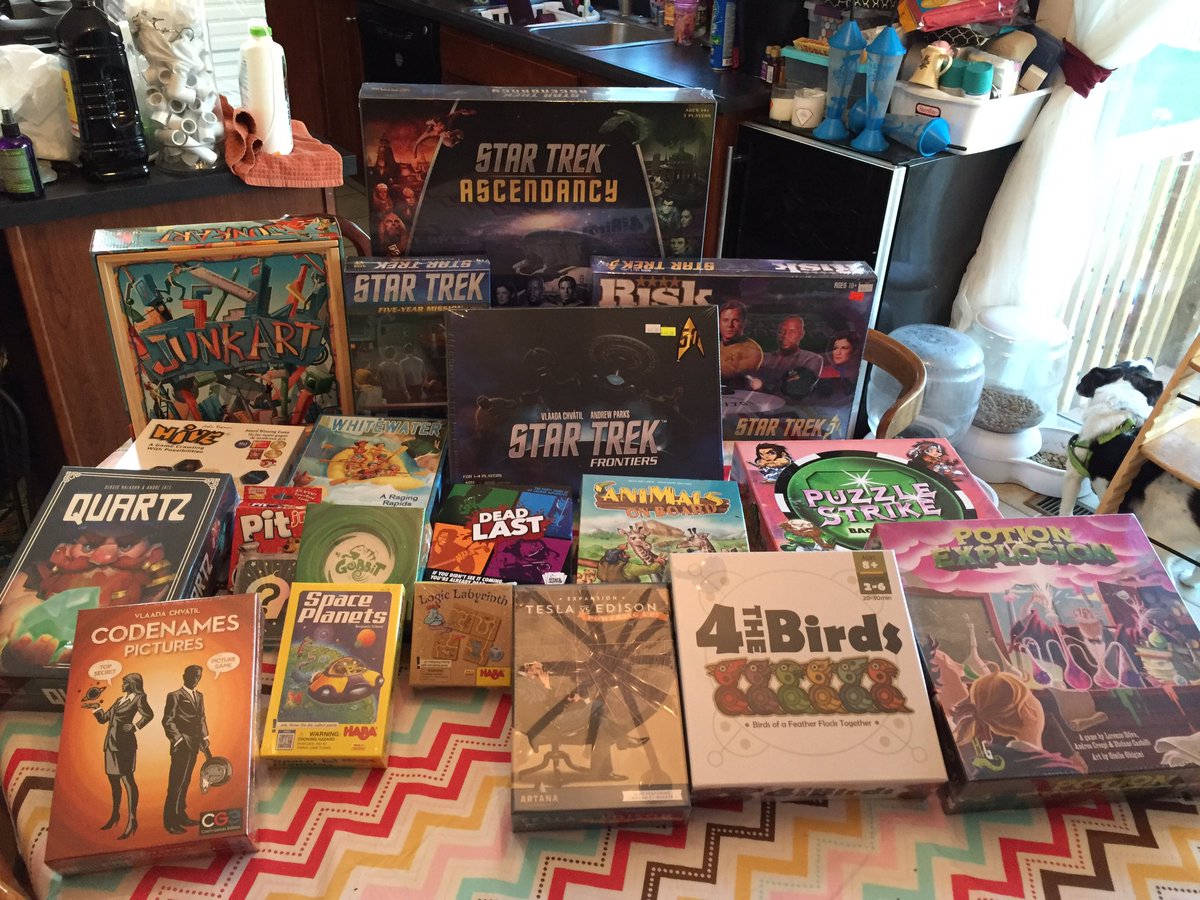
However, GenCon marks the major release for most board game products in the U.S., and I become a consumer at that show most years as well. Let's take a look at this year's haul, which is much larger than normal:


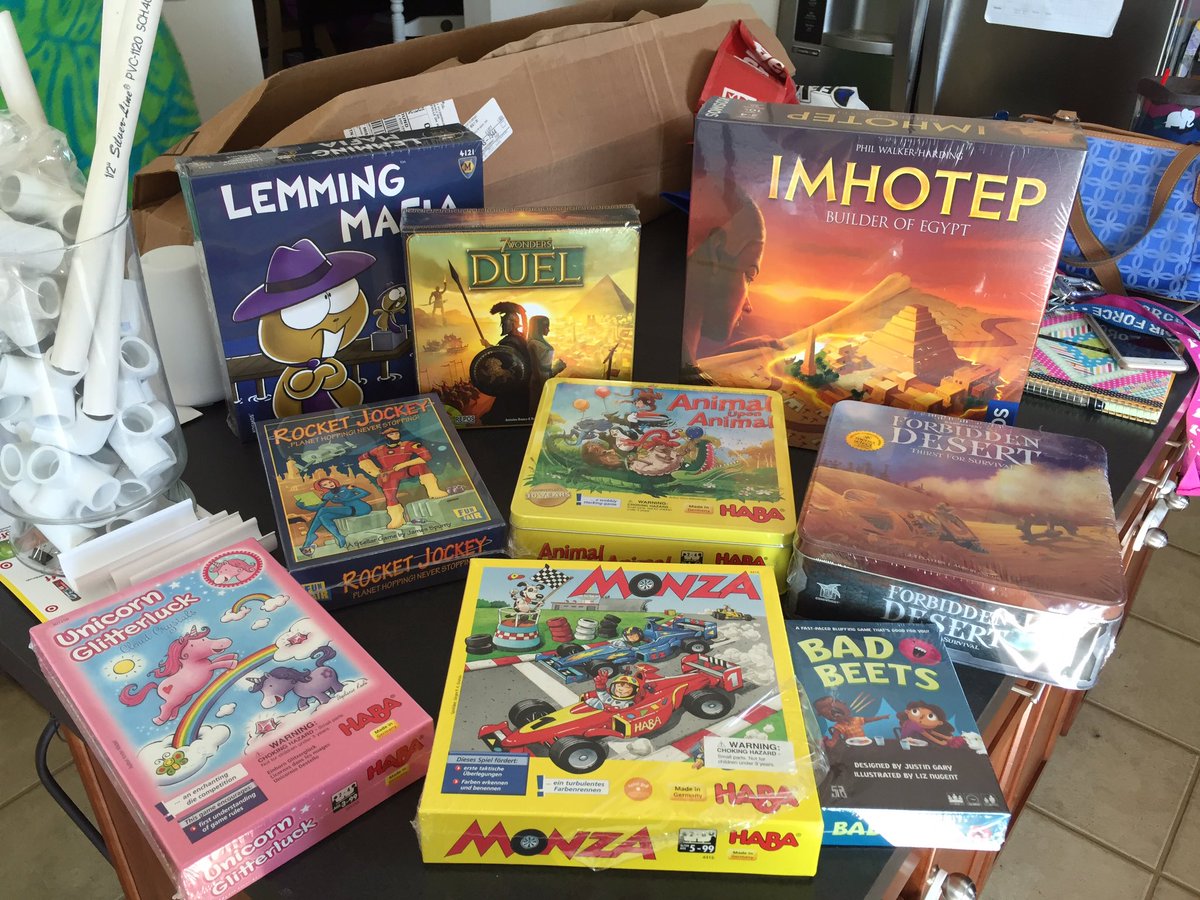
That's 20 games or expansions total. Wow! Even comparing that to Origins (picture below, only missing Karuba which I had shipped to me post-show), it's a lot:


To say we have some "new shinies" and "SEALWRAP!" to enjoy in the Fitzgerald household and with our gaming groups is an understatement. However, it's been fun diving into all of these new (or new to us) titles.

Many of these games are intended for play with the three daughters, but our oldest is turning 8 this week and she is honestly able to pick up and play even many of the games we bought intending for adults to play. That being said, the various HABA games you see have been a big hit, particularly simple stuff like Unicorn Glitterluck for the two younger daughters (5.5 and 2.5), who are way into princesses and pink and unicorns and My Little Pony and on and on.

For lighter gamers, we have had an absolute blast with all of the Spiel award nominees for 2016 (most prestigious game of the year award in the industry): Imhotep, Karuba, and Codenames. The new Codenames Pictures adds a very interesting element to the game when comparing it to the normal version with words, but both are fun. Hell, with that innovative design, you could play with Cards Against Humanity cards and still have a good time. There is a black box adult version of Codenames available now from Czech Games as well, FWIW.

I've more than doubled my Star Trek theme game collection thanks to the GenCon acquisitions, with many new titles being released on or around the 50th anniversary in 2016. The best of these for capturing the essence of Star Trek is definitely Ascendancy, but I should save my detailed thoughts on that for a future entry. It's been an absolute blast playing Star Trek Risk and other co-op games with Paige, our oldest. She is just as much into Star Trek as I am, and risk is a game you just have to pass down from generation to generation, even though it's not the best game design. For more of my thoughts on Star Trek games, check out my Character Insight segments from August which played on the This Week in Trek podcast:


HOUSE RULES

The other topic I want to briefly discuss today is the importance of using House Rules. Certainly game designers try their best to make games as good as possible, but there are times when the rules just are not ideal, or not ideal for certain player counts. I've run into this issue a few times while playing the new games from the summer conventions.

For example, simplifying games for use with kids can make for a game that hits the table far more frequently than it would otherwise. The missing rules can be added back in as the children grow more comfortable with the game and more adept as gamers.

Star Trek Risk has a basic rule set without the event cards and quests and crew member abilities which basically turns it into generic Risk. The difference between that and the full game with all of those features was a jump too high for Paige. Thus, I have experimented with adding one or two of these advanced rules at a time, and the result has been a fun and varied experience. We are getting different experiences from a single game, AKA more bang for the buck as we go. Legacy Games aren't the only games that can provide this!

Another game in this line is Potion Explosion, which has a very simple but fun tactile mechanic of pulling marbles from a box containing multiple rows of marbles to complete recipes for potions. Depending on the type of potion, they all give a special one-time use effect after you complete them. By simply removing this rule as an introductory version via House Rules for kids or teaching the game, the game is playable by even our middle child. It's still very fun as well!  I encourage those with kids to experiment with House Rules or removing rules to bring complexity levels down so you can play some of your favorite tabletop games for many more years as your kids grow up and hopefully become game enthusiasts themselves. I can't think of many better ways to spend quality time with the littles.

The final example I will give for today is Quartz (I have House Rules for Star Trek Ascendancy working as well but again, that's a discussion for its own post), which is identified as a press-your-luck type of game with "take that" player interactions with cards you can play against your other players. The basic game play is pulling gem stones out of a bag, which is again a fun tactile experience, and hoping to collect valuable colors of gems rather than black gems called Obsidian. In the rules as written in the rule book, you play 5 rounds of this and you "bust out" and get no points if you ever pull or get given (via the cards) a second Obsidian.

In my view, this leads to games which tend to be a bit too long for the type of experience being offered, and it also leads to player elimination feeling really bad when your first two gems are Obsidian and then you get to watch everyone else play, sometimes for a long time before you get back in during the next round. The game tries to temper this problem by giving you a token when you bust out for one-time use on a future day where you can remove an Obsidian instantly, such as when you would get a second, to save you that round. That does not seem like enough to solve this problem.

Thus, I developed House Rules for Quartz where you play 4 rounds instead of 5, and you bust out only when you get a third Obsidian. At least for 2 and 3 player games (2 player is not anticipated by the game but we've found it to work with another optional rule allowing the last player in the mine for the day to mine up to 4 more crystals), this has been brilliant because it actually captures the feel of other press-your-luck type games while slightly diminishing the mean aspects of the game where the "take that" cards can repeatedly bust someone out quickly in consecutive rounds. While this may not work as well for 4 and 5 players due to a limited number of Obsidian being in the gem bag (I'd still recommend 4 rounds as that's enough to have a full game experience), the change has totally revamped Quartz into a game that will see the table a lot in our family.

UPDATE: Have played with 4 with these house rules, and the only change I would recommend is to remove the tokens you get for busting out.  Those tend to be too powerful and make rounds go too long when you are not busting out at 2 Obsidian.  This may also be correct in the 2 or 3 player version of the house rule game as well.

Put simply, don't be afraid to experiment with House Rules. Sure, you have to sometimes be creative like a game designer, but it can make your game collection far more versatile and enjoyable. Until next time, happy gaming.